Rewild Genomics / De-extinction Programs / Short-Faced Bear
Extinct · ~11,000 BP

Short-Faced
Bear

Arctodus simus

The largest terrestrial carnivore in North American history. Long-legged, fast, and built for open ground, it dominated the continent's megafaunal communities for over a million years before vanishing at the close of the Pleistocene.

~1.5M
Years on Earth
~1.8m
Shoulder height
~900 kg
Maximum mass
Carnivora
Order
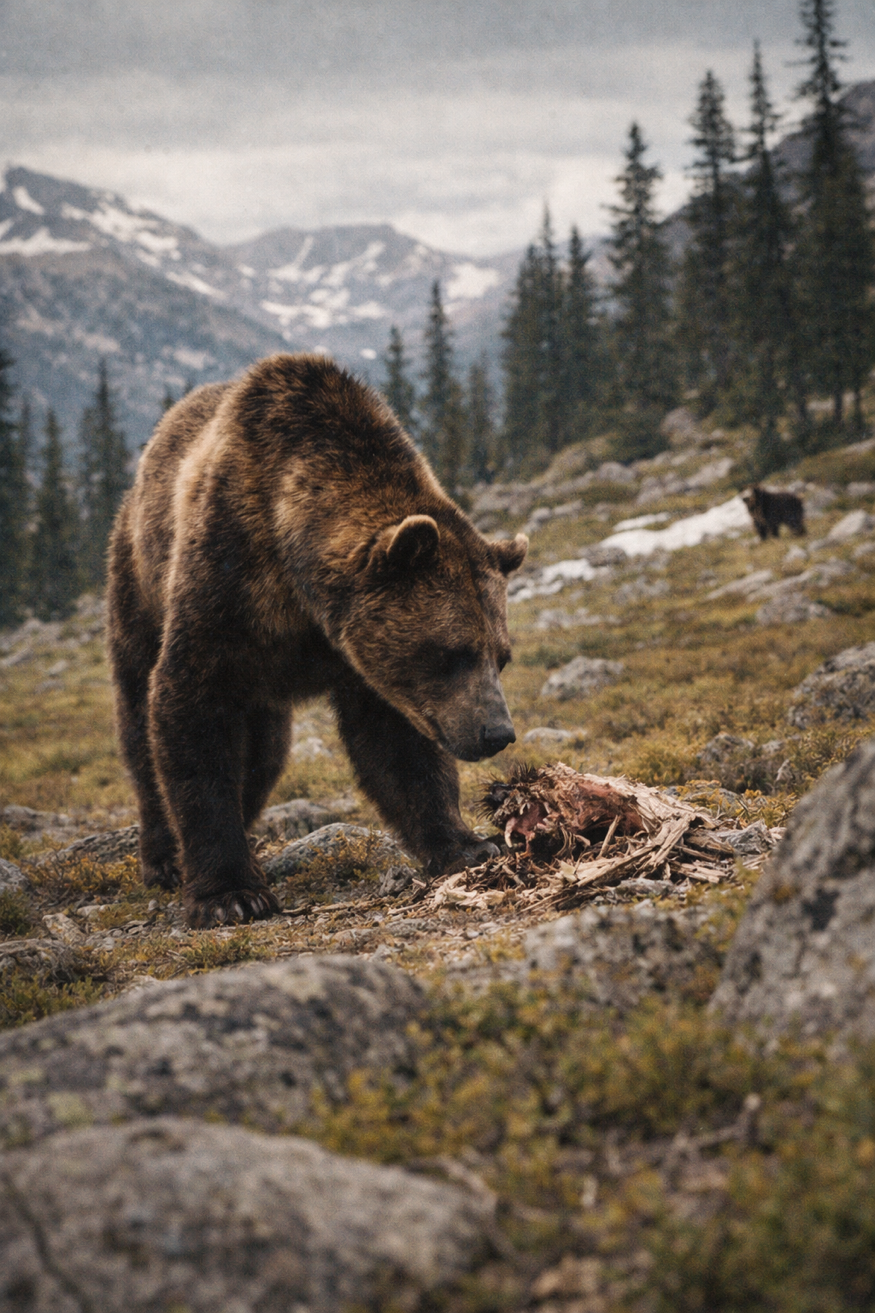
Brown bear in alpine landscape, proxy species for the short-faced bear
Proxy species · Brown bear, alpine terrain

Built for
open ground

The short-faced bear's name comes from its compressed, domed skull. The face was more abbreviated than a modern bear's, with a broader, forwards-set profile. But the more striking feature was the body: long, gracile limbs relative to its mass, giving it a rangy, high-shouldered silhouette that no living bear species shares.

That anatomy suggests a fast, pursuit-capable predator. Or possibly a wide-ranging scavenger that could cover enormous distances across the open grasslands and shrub-steppes of Pleistocene North America. Some researchers argue it was hypercarnivorous, displacing other predators from kills the way spotted hyenas work over lions today. Others see a more omnivorous strategy, something like a modern grizzly but scaled up dramatically. The debate hasn't been settled.

What isn't in dispute is the dominance. For over a million years, the short-faced bear held the top of the food chain in North America, larger than any living bear, and likely a serious organizing force on everything living around it.

"The short-faced bear's long limbs may have made it capable of running down horses across open Pleistocene grasslands."

The bear's closest living relative is the South American spectacled bear (Tremarctos ornatus), the only surviving member of the tremarctine bear lineage. Tremarctines split from the main ursid family in the Miocene and colonized North America, eventually producing Arctodus. This is a lineage entirely separate from brown bears, polar bears, and black bears.

That evolutionary distance matters for genomics work. The spectacled bear is a viable reference, but it's considerably more diverged from the short-faced bear than, say, the brown bear was from the cave bear. A lot of short-faced bear traits will need to be reconstructed from scratch rather than pulled across from a living proxy.

End of
the apex

The short-faced bear vanished around 11,000 years ago, at the close of the Pleistocene. It was part of the broader North American megafaunal collapse that wiped out roughly 70% of large mammal genera on the continent in a geologically short window.

The causes are still debated. Humans arrived in North America somewhere between 15,000 and 13,000 BP, and the megafauna had no prior experience with that kind of hunting pressure. Clovis hunters could kill mammoths and mastodons. A bear that competed directly with human hunters over the same prey would have faced pressure from multiple directions at once.

At the same time, Pleistocene warming was reshaping North American landscapes. The open steppe-grasslands that had supported dense megafaunal communities shrank and gave way to boreal forest and shrubland. A bear built for open-terrain pursuit on vast grasslands was suddenly in the wrong habitat with a diminishing prey base.

Early genomic analyses hint that the population was already contracting before humans arrived in force, suggesting a slow decline followed by a rapid collapse once hunting pressure and habitat loss hit at the same time.

~1,500,000 BP
Emergence and expansion
Arctodus simus emerges from earlier tremarctine lineages in North America and rapidly spreads from Alaska to Mexico. The species quickly establishes itself as the dominant large carnivore on the continent.
~500,000–30,000 BP
Peak abundance
Short-faced bears range across North America alongside mammoths, mastodons, giant ground sloths, and horses. Their remains are found in the La Brea tar pits alongside sabertooth cats and dire wolves.
~15,000–13,000 BP
Humans enter North America
Clovis and pre-Clovis peoples spread rapidly south from Beringia. The megafauna of North America had no prior evolutionary experience with this level of human hunting pressure.
~13,000–11,500 BP
Rapid population collapse
Genomic signals suggest sharp contraction. Loss of prey species, habitat transformation under climate warming, and direct hunting combine into a cascade the bears cannot survive.
~11,000 BP
Final extinction
The last short-faced bears disappear from the fossil record. Their bones persist across the continent, from the La Brea Tar Pits of California to the caves of Kentucky. A record of a species that once ruled a continent.
Factor 01
Human Hunting
When skilled hunters arrived in North America, the megafauna had no evolutionary history with that kind of pressure. As an apex predator, the short-faced bear faced both direct conflict hunting and the collapse of the prey populations it depended on.
Factor 02
Prey Collapse
The short-faced bear's body was built for speed and power across open ground. It needed a prey-rich ecosystem to sustain itself. As mammoths, horses, and ground sloths disappeared, the math stopped working for a carnivore pushing 900 kg.
Factor 03
Habitat Transformation
Pleistocene warming replaced open grasslands with denser woodland ecosystems. A bear that hunted by covering ground quickly across open terrain was not well suited to the forested North America that took shape after the ice pulled back.
Genomics research

A distinct
American lineage

Genomic work on Arctodus simus is less developed than for Eurasian megafauna like the woolly mammoth or woolly rhinoceros. Permafrost-preserved specimens from Alaska and the Yukon are the most promising source of extractable ancient DNA, and some have already yielded usable material. The cold, stable chemistry of subarctic deposits is what makes this possible at all.

The tremarctine lineage split from the broader bear family roughly 13 million years ago. The spectacled bear (Tremarctos ornatus) of South America is the short-faced bear's closest living relative and serves as our primary reference genome. The deep divergence means many short-faced bear traits will need to be reconstructed de novo rather than transferred from a living proxy, which makes this one of the more technically demanding projects in our program.

The main research targets are the locomotor loci responsible for the bear's distinctive long-limbed body plan, body size regulation, and dietary markers that might finally resolve whether Arctodus was primarily a carnivore or more of a generalist at the population level.

Research program: Short-Faced Bear

Rewild Genomics is pursuing aDNA extraction and assembly from permafrost-preserved Alaskan and Yukon specimens, with the goal of producing a reference-quality nuclear genome for Arctodus simus. The spectacled bear (Tremarctos ornatus) serves as the primary extant reference.

Priority loci include those tied to limb proportion and cursorial locomotion, a unique evolutionary experiment in bear biology, alongside body size regulation and dietary adaptation markers. As the only North American apex carnivore in our program, the short-faced bear occupies a largely unexplored corner of Pleistocene genomic space.

Permafrost specimens Spectacled bear proxy Locomotor loci NCBI / GenBank Dietary adaptation

Continue exploring species programs

Six de-extinction research programs, all built on publicly available genomic data.

← Back to all species