Rewild Genomics / De-extinction Programs / Irish Elk
Extinct · ~7,700 BP

Irish
Elk

Megaloceros giganteus

The largest deer that ever lived, carrying antlers spanning up to 3.7 meters — a structure so extreme it became a textbook example of evolutionary excess, and almost certainly a factor in its own undoing.

~400K
Years on Earth
~2.1m
Shoulder height
~700 kg
Body mass
Cervidae
Family
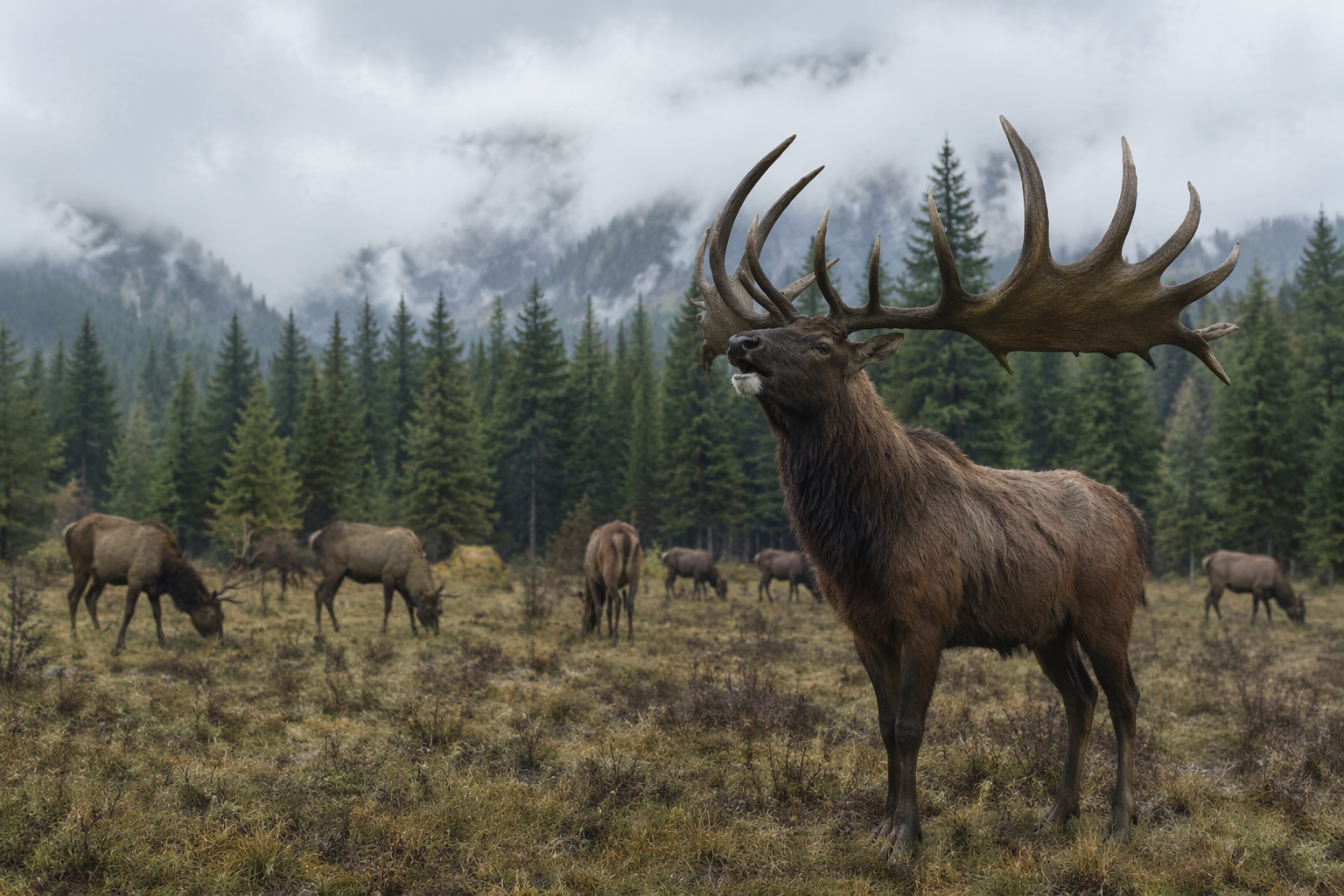
Bull elk with massive palmate antlers bugling before a herd in a misty mountain meadow
Megaloceros giganteus · Cervidae

The deer that outgrew the world

Despite the name, the Irish Elk was neither exclusively Irish nor strictly an elk. Megaloceros giganteus ranged from Ireland to China, across the Eurasian steppe and into North Africa, wherever open grassland and shrubland could support an animal of its size. The name comes from the remarkable density of specimens preserved in Irish peat bogs.

It was a cervid — part of the same family as modern red deer and moose — but it dwarfed them. Stags stood over two meters at the shoulder and carried antlers that could weigh 40 kilograms on their own, with a span wider than a car is long. Those antlers were shed and regrown every year, requiring calcium and phosphorus at rates that strained the animal's skeletal reserves.

Isotopic studies of bone collagen suggest Irish Elk were highly sensitive to plant quality. They thrived on the mineral-rich vegetation of open steppe and parkland. When that vegetation changed, they struggled.

"Forty kilograms of antler, shed and rebuilt every year. No other deer ever attempted anything close."

Cave paintings at Lascaux and Cougnac preserve some of the clearest evidence of what these animals looked like in life — a distinctive shoulder hump and dark dorsal stripe appear consistently across multiple sites, suggesting artists were working from direct observation.

Their social behavior was almost certainly comparable to modern large deer: dominant stags using antler display and combat to compete for females during the rut. The antlers' enormous size likely functioned primarily as a visual signal of male fitness, with actual combat a secondary use.

Some populations survived well into the Holocene. The last known individuals, in western Siberia and possibly the Ural Mountains, disappeared around 7,700 years ago — thousands of years after most megafauna extinctions, and long after humans had been present across their range.

Too large,
too specialized

The Irish Elk was caught between two forces: climate change reshaping their habitat, and a body plan that had become increasingly difficult to sustain. The end of the last glacial maximum brought forest expansion across Eurasia, replacing the open steppe the species depended on with denser woodland it was poorly equipped to navigate.

Antlers spanning 3.7 meters are not well suited to moving through trees. But the deeper problem may have been nutritional. The annual antler cycle demanded extraordinary mineral input, and as steppe vegetation gave way to lower-quality forest forage, stags may have struggled to build viable antlers at all. Evidence from bone chemistry shows declining nutritional status in late Irish Elk populations.

Human hunting likely compounded the pressure. Irish Elk appear in archaeological butchering sites, and by the time their last habitats were shrinking, even modest hunting pressure on a slow-reproducing megafaunal deer could accelerate the collapse.

~400,000 BP
Species emerges
Megaloceros giganteus evolves across Eurasia, occupying open grassland and steppe environments from the British Isles to central Asia and the Levant.
~20,000–14,000 BP
Peak abundance
Irish Elk reach their widest range during the Late Pleistocene. Cave art at Lascaux captures stags with their characteristic shoulder hump and massive palmate antlers.
~12,000–10,000 BP
Western range collapse
As the last glacial maximum ends, forests spread across western Europe. Irish Elk populations in Ireland and western Europe disappear rapidly as open habitat fragments.
~7,700 BP
Final extinction
The last known populations, persisting in western Siberia, disappear. Radiocarbon dates from Ural and Siberian specimens mark the end of the species.
Factor 01
Habitat Loss
Post-glacial forest expansion eliminated the open steppe and parkland Irish Elk required. Their body plan — both in terms of antler span and mineral demands — was built for open environments, not dense woodland.
Factor 02
Nutritional Stress
Annual antler regeneration at this scale required exceptional mineral intake. As vegetation quality declined with habitat change, bone chemistry from late specimens shows clear evidence of nutritional stress and reduced body condition.
Factor 03
Human Hunting
Irish Elk remain in archaeological contexts across their late range, and human hunting pressure on a nutritionally stressed, slow-reproducing population would have accelerated collapse even if it was not the primary driver.
Genomics research

What the genome
tells us

Ancient DNA from Irish Elk specimens has been successfully extracted and analyzed, largely from the well-preserved bog specimens in Ireland and permafrost deposits further east. Mitochondrial genome sequences are available in NCBI, and nuclear genomic data is accumulating from ongoing paleogenomics work.

Phylogenetically, Megaloceros sits within the Cervidae and is most closely related to the fallow deer (Dama dama), with a divergence time estimated at roughly 3 to 4 million years ago. This is a closer relationship than many extinct megafauna share with their living analogs, which has implications for any future de-extinction pathway.

The most genomically interesting question is the genetic architecture of the antler growth program — the loci controlling rate, size, mineralization, and annual cycling of the most elaborate antler structure in cervid evolutionary history. Identifying those variants in the Megaloceros genome is a tractable comparative genomics problem.

Research program: Irish Elk

Rewild Genomics is developing comparative genomic pipelines for Megaloceros giganteus, focusing on the divergent loci controlling antler development, body size, and mineral metabolism relative to fallow deer and other extant cervid outgroups. The antler growth program is among the most extreme morphological specializations in mammalian evolutionary history, and understanding its genetic basis has implications for bone biology well beyond de-extinction.

Our approach draws on publicly available mitochondrial and nuclear sequence data, with a focus on building open-source pipelines for aDNA analysis of cervid specimens from Holocene and late Pleistocene deposits.

mtDNA available NCBI / GenBank Megaloceros giganteus Fallow deer proxy Antler development loci In development

Continue exploring species programs

Six de-extinction research programs, all built on publicly available genomic data.

← Back to all species