Rewild Genomics / De-extinction Programs / Caribbean Monk Seal
Extinct · 1952

Caribbean
Monk Seal

Neomonachus tropicalis

The only seal native to the Caribbean and Gulf of Mexico, hunted to extinction within four centuries of sustained contact. The last confirmed sighting was 1952. Two living relatives, both endangered, provide strong genomic scaffolding for reconstruction.

~230 kg
Body mass
1952
Last confirmed
2008
Declared extinct
Phocidae
Family
Caribbean monk seal resting on a tropical beach, speculative rendering
Speculative rendering · Neomonachus tropicalis

The Caribbean's lost seal

The Caribbean monk seal was the only pinniped endemic to the Caribbean Sea and Gulf of Mexico. It occupied a unique ecological niche: a large marine predator adapted to warm tropical and subtropical waters, hauling out on low coral reefs, sandy cays, and isolated beaches across a range stretching from the Bahamas to the Yucatan and into the Gulf.

Adults were large-bodied and robust, brownish-gray above and yellowish-white below, with males reaching roughly 2.4 meters. They fed primarily on reef fish, eels, and invertebrates in the shallow coral systems that once dominated the Caribbean. Their loss likely contributed to cascading changes in reef community structure that continue to play out today.

Christopher Columbus encountered monk seals on his second voyage in 1494, recording them as sea wolves. His crew killed eight for food. That encounter set the template for the next four centuries of human contact with the species: easy to approach, with no learned fear of people, and killed without restraint wherever encountered.

Sea wolves, lying on the rocky shore. We killed eight of them as they slept. Columbus expedition log, 1494. The species had 458 years left.

The monk seal's tameness was a product of island evolution. With no terrestrial predators in its history, it had no reason to flee. Hunters did not need sophisticated methods. Seals hauled out on beaches in groups and could be killed with clubs. Historical accounts describe dozens of animals taken in a single visit.

The species was also targeted for its oil-rich blubber, which rendered into lamp and machine oil. Commercial sealing in the late 19th century accelerated population decline sharply. By 1900, the species had been pushed from a range-wide distribution to scattered remnant groups on the most remote reefs.

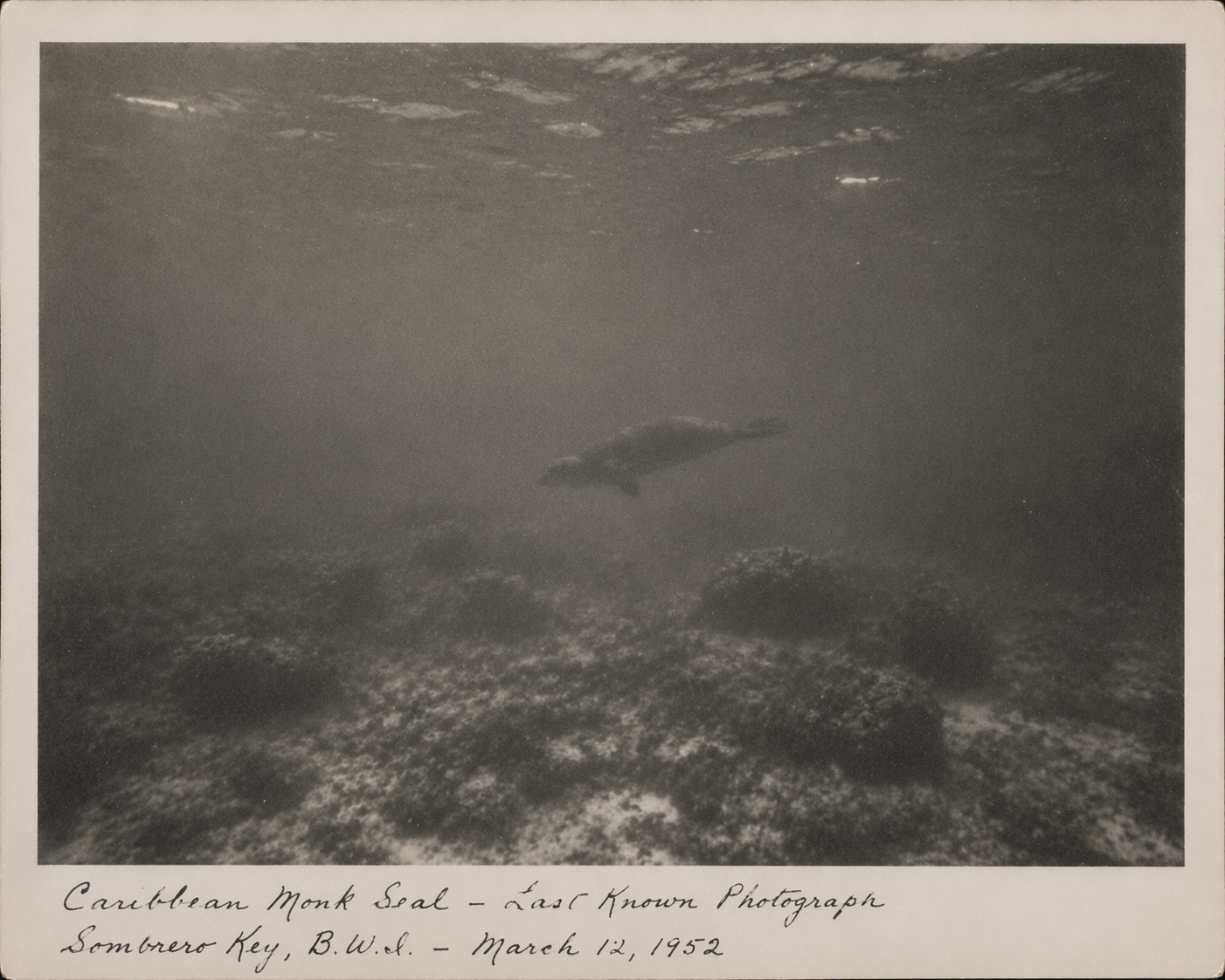
A small colony at Triangle Rocks off the Yucatan coast persisted into the 1950s. The last confirmed sighting was in 1952. No verified observation has been recorded in over 70 years, and a five-year survey completed in 2008 found no evidence of surviving animals, leading NOAA to declare the species officially extinct.

What was left behind

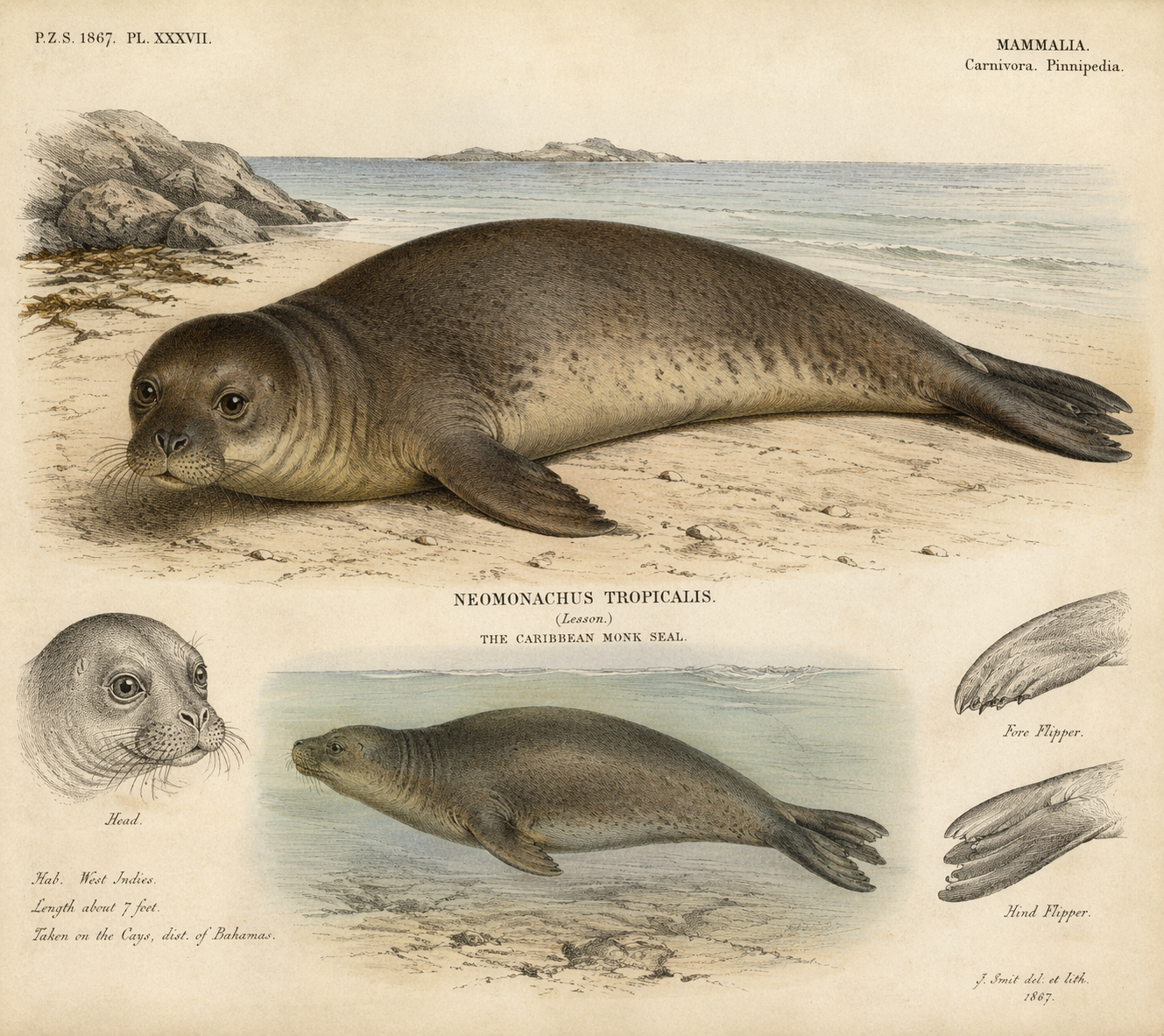
1867 scientific illustration of the Caribbean monk seal, Neomonachus tropicalis, from Proceedings of the Zoological Society of London
P.Z.S. 1867, Pl. XXXVII — J. Smit del. et lith. · Neomonachus tropicalis (Lesson) · The Caribbean Monk Seal
Last known photograph of a Caribbean monk seal, taken underwater at Sombrero Key, British West Indies, March 12, 1952
Caribbean Monk Seal — Last Known Photograph · Sombrero Key, B.W.I. — March 12, 1952

Hunted out of existence

The Caribbean monk seal's extinction is one of the clearest cases of direct human predation driving a marine mammal to extinction in the historical record. There is no climate angle, no habitat loss, no introduced competitor. Humans killed them until none were left.

The species had no evolved wariness of people because it had no terrestrial predators before European contact. The reefs and cays it occupied were remote enough to offer some protection in the pre-industrial era, but no protection once systematic commercial hunting began. The population had no capacity to recover between hunting seasons because the hunters returned to the same sites year after year.

The extinction is also a lesson in how long false hope can persist. Occasional unverified sightings were reported through the 1970s, and the species was not formally declared extinct until 2008, fifty-six years after the last confirmed record. That delay reflects both the difficulty of proving absence across a large ocean range and a reluctance to accept that a species within living memory could be entirely gone.

1494
First contact
Columbus expedition crew kills eight Caribbean monk seals at a haulout site on the second voyage. The encounter is recorded in the expedition log as the first documented hunting of the species.
Late 1800s
Commercial hunting
Oil rendering operations systematically exploit monk seal haulout sites across the Caribbean. Population collapses from a range-wide distribution to scattered remnant groups on the most remote reefs.
1911
Last large colony documented
A colony at Triangle Rocks off the Yucatan coast is documented by researchers, one of the last known breeding aggregations. The colony persists in diminished form through the mid-20th century.
1952
Last confirmed sighting
A small group observed at Triangle Rocks. No verified sighting is recorded after this date. Surveys over the following decades find no evidence of surviving animals.
2008
Declared extinct
NOAA formally declares the Caribbean monk seal extinct following a five-year survey that found no evidence of surviving animals anywhere within the historical range.
Factor 01
Direct Hunting
Caribbean monk seals were killed for food, oil, and as nuisances to fishing operations across four centuries. Their behavioral tameness, evolved in the absence of terrestrial predators, made them easy targets.
Factor 02
Island Naivety
Like many island-evolved species, Caribbean monk seals had no learned fear of terrestrial predators. They did not flee human approach. This behavioral trait, adaptive for millions of years, became a fatal vulnerability within decades of sustained contact.
Factor 03
No Recovery Opportunity
Commercial hunters returned to the same haulout sites year after year, preventing any population recovery between exploitation events. Monk seals typically produce one pup per year. The math allowed no escape.
Genomics research

Two living relatives,
one extinct lineage

The Caribbean monk seal belongs to the genus Neomonachus, which it shares with one living species: the Hawaiian monk seal (Neomonachus schauinslandi). The Mediterranean monk seal (Monachus monachus) is a close outgroup. Both living monk seal species are critically endangered, which means their genomes are well-characterized and publicly available as conservation resources.

Mitochondrial DNA has been extracted from Caribbean monk seal museum specimens, confirming its placement within Neomonachus. The divergence between Caribbean and Hawaiian monk seals is estimated at roughly 3 to 4 million years ago. In evolutionary terms that is relatively recent, meaning the genomic distance between the two species is modest.

This close relationship makes the Hawaiian monk seal the natural proxy candidate. The two species share the same genus, similar body plans, and comparable ecological roles in their respective reef systems. The core comparative genomics question is which variants in the Caribbean monk seal differ from the Hawaiian monk seal baseline, and which of those variants encode traits worth recovering.

Museum collections hold Caribbean monk seal specimens with recoverable DNA, including skin, bone, and potentially soft tissue material from 19th and early 20th century collections. Combined with the well-characterized Hawaiian monk seal reference genome, that material provides a tractable starting point for a genomics program.

Research program: Caribbean Monk Seal

Rewild Genomics is developing comparative genomic pipelines for Neomonachus tropicalis, drawing on museum specimen aDNA and the publicly available Hawaiian monk seal reference genome. The program targets identification of Caribbean-specific divergent loci: thermal adaptation to warm tropical waters, reef-specific foraging behavior genetics, and population structure across the historical range.

The conservation angle runs in both directions. Understanding Caribbean monk seal adaptation may yield insights relevant to Hawaiian monk seal conservation. A species recovered from museum specimens and returned to Caribbean reef ecosystems would represent a significant ecological restoration alongside any genomic achievement.

Museum specimen aDNA NCBI / GenBank Neomonachus tropicalis Hawaiian monk seal proxy Phocidae comparative genomics In development

Continue exploring species programs

Pleistocene and historical de-extinction targets, all built on public genomic data.

← Back to all species